
Product Owner Vision and Product Goals
Product Owners need to help teams understand where the product is going and what matters now.
That requires both product vision and product goals.
A product vision describes the larger direction for the product. A product goal creates nearer-term focus. Together, they help the Product Owner, team, and stakeholders decide what belongs in the backlog, what should come next, and what can wait.
A Product Owner does not need to predict the future perfectly. Product development includes too much uncertainty for that. But the Product Owner should provide enough direction that the team is not merely working through a list of requests.
Who This Page Is For
This page is for Product Owners, product managers, Scrum Masters, agile coaches, Developers, managers, and stakeholders who want clearer product direction and better backlog decisions.
It is especially useful when a team is busy but unfocused, when stakeholders keep pulling the product in different directions, or when the product backlog contains many items but no clear sense of why those items matter now.
In This Page
You will learn how product vision and product goals work together, what makes a vision useful, how goals guide backlog decisions, and how Product Owners can provide direction without dictating solutions.
You will also learn common problems with weak vision and vague goals, plus practical questions for improving product direction.
What Is Product Vision?
A product vision is a clear description of the future the Product Owner wants the team to help create.
It should help answer questions such as:
- Who is this product for?
- What problem are we trying to solve?
- Why will customers, users, or the organization care?
- What will make the product valuable or different?
- What important constraints or boundaries should the team understand?
A vision does not need to be long. It does need to be useful.
The best visions give people enough direction to make better decisions. They help the team choose among options. They help stakeholders understand why some requests move forward and others do not. They help the Product Owner explain why the current work matters.
A vague vision may sound inspiring, but it will not guide decisions. A vision that is too detailed may leave the team no room to find a better solution.
A Good Vision States the Goal, Not the Solution
A Product Owner should usually describe the goal to achieve, not the exact solution to build.
A classic example is U.S. President Kennedy’s goal of landing a person on the moon and returning that person safely to Earth before the end of the decade of the 1960s. The goal was clear. It did not tell NASA exactly how to build the rocket, design the spacecraft, or solve every engineering problem.
That is the kind of direction teams need from a Product Owner.
A Product Owner might say, “We need customers to renew their subscriptions without calling support.” That gives the team a useful goal. The team may then explore self-service renewal, better reminders, payment updates, subscription dashboards, support prompts, or other options.
If the Product Owner instead says, “Build this exact renewal screen with these fields in this order,” the team has less room to bring its design, technical, testing, and product knowledge to the solution.
Sometimes boundaries matter. The Product Owner may need to say the solution must work on mobile, comply with a regulation, support an existing contract, or be ready before a market event.
Those boundaries shape the solution space. They should not replace the team’s responsibility to help find the best solution.
What Makes a Vision Useful?
A useful product vision is clear, elevating, and flexible.
Clear
The team should be able to tell whether it is moving toward the vision.
“Improve usability” may be directionally true, but it is not very useful by itself. Improve usability for whom? In what workflow? What would be better after the change?
Clear vision does not require excessive precision. It requires enough clarity for the Product Owner, team, and stakeholders to make better choices.
Elevating
A useful vision gives the team a reason to care.
Revenue, cost savings, and market share may matter to the organization. But teams often do their best work when they also understand how the product helps customers, users, or the people who depend on the product.
An elevating vision helps the team see the human or business problem behind the backlog items. It gives the work a purpose beyond completing the next ticket.
Flexible
A good vision gives the team enough degrees of freedom to find the best way to achieve the goal.
If the goal is too prescriptive, the team has little room to use its expertise. If the goal is too loose, almost any solution can seem acceptable.
The Product Owner should provide the outcome, important boundaries, and tradeoffs. The team should have enough freedom to discover a good solution within those boundaries.
What Is a Product Goal?
A product goal is a shorter-term objective that helps the team move toward the product vision.
If the product vision describes the larger direction, product goals define what matters next.
A product goal might be:
- Reduce the number of support calls related to subscription renewal.
- Help first-time users complete setup without assistance.
- Make reporting useful enough for managers to check it weekly.
- Enable one customer segment to complete a workflow that currently requires manual help.
- Validate whether customers will use a new integration before investing in the full implementation.
Product goals are useful because they narrow attention. They help the Product Owner decide which backlog items matter now and which can wait.
Without product goals, the backlog can become a collection of requests. With product goals, the backlog becomes a path toward a meaningful outcome.
Product Goals Help Prioritize the Backlog
A Product Owner usually has more possible work than the team can do.
Product goals help make tradeoffs clearer.
When a stakeholder asks for a feature, the Product Owner can ask whether that request helps the team achieve the current product goal. If it does, the item may deserve attention. If it does not, the item may still be valuable, but perhaps not now.
This prevents every new request from competing equally with the work the team already agreed was important.
A product goal does not make decisions automatic. The Product Owner still needs judgment. But it gives the Product Owner a stronger basis for saying yes, no, or not now.
Vision and Goals Should Shape the Product Backlog
A product backlog should reflect current product direction.
The Product Owner should be able to explain why the items near the top of the backlog matter now. Some may directly support the current product goal. Others may reduce risk, create learning, satisfy a dependency, or improve the product enough to make the goal achievable.
If the backlog is full of items disconnected from the product vision and current goals, the team may still be productive but not necessarily effective.
Use vision and goals to decide:
- What should move toward the top of the backlog?
- What should remain lower for later consideration?
- What should be split so the most valuable part can be learned from sooner?
- What should be removed because it no longer fits?
- What uncertainty should be resolved before the team invests more?
The backlog should change as the Product Owner, team, and stakeholders learn.
Vision Is Shared, but Accountability Is Clear
The Product Owner does not create product vision alone in a dark room.
Good vision is informed by customers, users, stakeholders, business strategy, market knowledge, technical realities, and the team’s learning. Stakeholders may help shape the vision. Developers may expose possibilities or constraints the Product Owner did not know. Customers and users may reveal needs the organization has overlooked.
The vision should be shared.
But shared vision does not mean shared accountability for every product decision. The Product Owner remains accountable for making the product direction clear enough that the team can act.
When a vision is owned by everyone equally, it often becomes no one’s job to resolve disagreement. The Product Owner should listen widely, then help turn input into clear direction.
Use Vision to Guide, Not Control
A vision should help the team make better decisions. It should not be used to control every decision.
The Product Owner should bring the problem, goals, constraints, and priorities. The team should help discover the best way to solve the problem.
For example, a Product Owner may know that customers are abandoning checkout because shipping surprises appear too late. That is useful product direction. The team can then explore ways to show shipping estimates earlier, simplify shipping options, improve messaging, or change the checkout flow.
The Product Owner should stay engaged in those conversations because different solutions may create different product tradeoffs. But the Product Owner should avoid assuming the first imagined solution is the only acceptable one.
Better solutions often appear when the team understands the goal and has room to think.
Validate Assumptions Before Turning Vision Into Backlog
A vision often contains assumptions.
The Product Owner may assume a customer segment has a problem, that the problem is important, that users will accept a new workflow, that the organization can support a new service, or that a feature will create a business result.
Those assumptions should influence the backlog.
If an assumption is risky and important, the Product Owner may want the team to learn about it early. That might mean talking with users, testing a prototype, building a small version, running an experiment, or delivering a narrow feature that reveals whether the direction is promising.
The goal is not to eliminate all risk before building anything.
The goal is to avoid filling the backlog with work based on untested assumptions that could have been challenged sooner.
Common Product Vision and Goal Problems
Common problems include:
- The vision is too vague. If the team cannot use the vision to choose between options, the vision needs more clarity.
- The vision is really a solution. A feature, screen, workflow, or architecture may be useful input, but the team still needs to know the goal behind it.
- Goals change too often. Change direction when new information warrants it, not every time a new stakeholder request appears.
- Goals are too far away. A long-term vision is useful, but the team also needs nearer-term focus.
- Goals are too output-focused. “Build five reports” is less useful than “Help managers identify overdue work sooner.”
- The backlog does not reflect the goal. If the Product Owner says one goal matters but the top of the backlog points somewhere else, the team receives mixed signals.
Are Vision and Goals Helping the Team?
Use these questions to find the next conversation the Product Owner, team, and stakeholders may need to have.
- Can the team explain who the product is for and what problem it solves?
- Can stakeholders explain the current product goal in similar terms?
- Does the product goal help the Product Owner decide what belongs near the top of the backlog?
- Is the goal focused on an outcome rather than only a list of outputs?
- Does the team understand what tradeoffs are acceptable?
- Are important assumptions being tested early enough?
- Does the Product Owner provide direction without dictating every solution?
- Does the backlog change when the team learns something important?
- Are stakeholders using the goal to discuss tradeoffs instead of lobbying for disconnected requests?
- Is the goal clear enough to focus the team and flexible enough to leave room for a good solution?
This is not a scorecard. Use it to decide whether the next improvement should be a clearer vision, a better product goal, more stakeholder alignment, more user learning, or a backlog that better reflects the direction.
Common Questions About Product Owner Vision and Goals
What Is Product Vision?
Product vision is a clear description of the future the Product Owner wants the team to help create.
It should explain who the product is for, what problem it solves, why it matters, and what makes it valuable or different.
What Is a Product Goal?
A product goal is a shorter-term objective that helps the team move toward the product vision.
It gives the Product Owner and team a practical way to decide what matters now.
Does the Product Owner Create the Vision Alone?
No.
The Product Owner should involve customers, users, stakeholders, and the team. But the Product Owner remains accountable for making product direction clear enough that the team can act.
What Is the Difference Between a Product Goal and a Sprint Goal?
A product goal describes a product outcome the team or teams are working toward over a longer period.
A Sprint Goal describes the purpose of one sprint. A good Sprint Goal should usually support the current product goal.
Should the Product Owner Tell the Team How to Build the Solution?
No.
The Product Owner should explain what outcome is needed, why it matters, and what constraints apply. The team should determine how best to achieve that outcome.
Recommended Articles
Building a Product Users Want: from Idea to Backlog with the Vision Board
Explains how a product vision can be connected to the product backlog by clarifying users, needs, differentiators, and business goals.
What Is a Product?
Useful when product vision and product goals are unclear because the organization has not clearly defined the product.
Product Owners Should Prioritize Importance Over Urgency
Helps Product Owners keep important product goals from being displaced by short-term fires.
Now Vs. Not-Now Prioritization Along with Medium-Term Goals
Shows how a medium-term goal can support practical prioritization decisions.
What Does a Product Owner Do, When, and Why?
Explains how Product Owner responsibilities happen over time, including vision, quarterly work, sprint-by-sprint decisions, and ongoing adaptation.
Six Ways to Become a Great Product Owner
Includes practical guidance on the vision, availability, collaboration, and flexibility teams need from Product Owners.
Related Pages
Product Owner Role and Responsibilities
Learn how Scrum defines the Product Owner accountability and how the role works with the Scrum Team.
How to Prioritize a Product Backlog
Learn how to use formal prioritization for larger planning decisions and lighter adjustments before each sprint.
Product Backlog
Learn how to keep a product backlog useful, ordered, appropriately detailed, and ready enough for Sprint Planning.
Product Backlog Refinement
Learn how Product Owners and teams refine upcoming work enough to make responsible Sprint Planning decisions.
All Articles on This Subtopic
Explore Mountain Goat Software articles related to Product Owner vision, product goals, product direction, product boundaries, prioritization, stakeholder alignment, and turning ideas into backlog decisions.
Product Owner Vision and Product Goals
- Building a Product Users Want: from Idea to Backlog with the Vision Board
- What Is a Product?
- Product Owners Should Prioritize Importance Over Urgency
- Now Vs. Not-Now Prioritization Along with Medium-Term Goals
- What Does a Product Owner Do, When, and Why?
- Six Ways to Become a Great Product Owner
Vision and Product Goals Resources
Vision and Backlog Scrum is a great framework for building a product with the right features. It encourages the use of a vision shared by the product owner, the ScrumMaster, the development team, and the stakeholders, and it provides a product backlog that allows the team to move towards the vision by creating
In this agile principles post from Mike Cohn, discover how Scrum organizations define products. Learn why good product definition avoids problems related to agile team structure, product backlog management, and Scrum roles.
Product owners often sacrifice progress toward important goals to put out short-term fires. There’s a way to stop that.
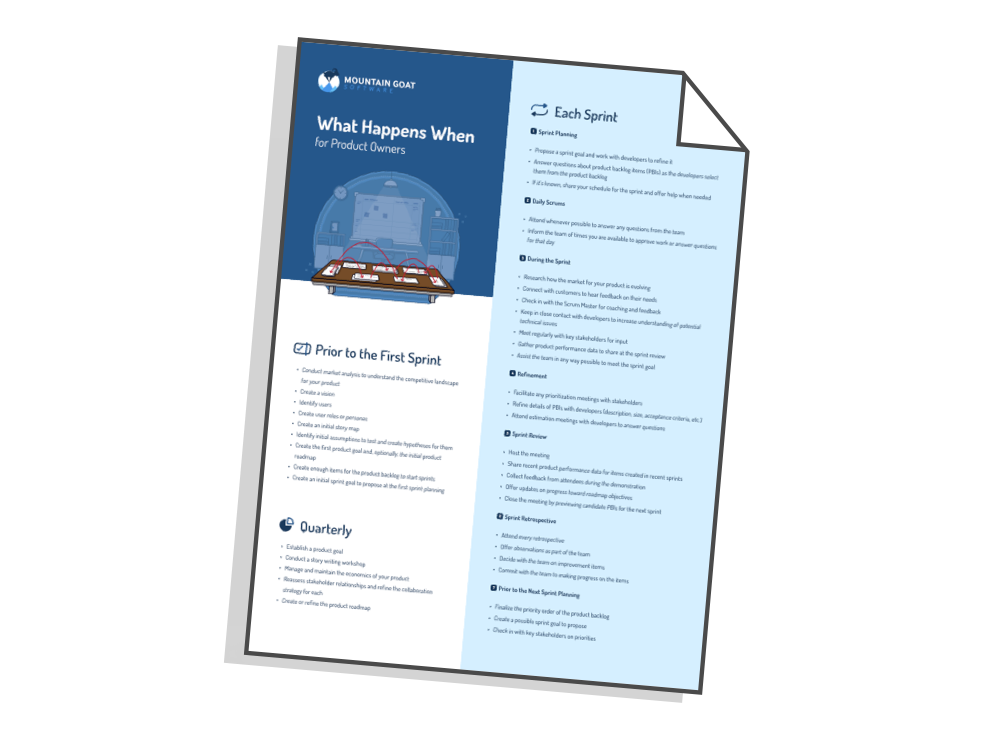
A downloadable guide for understanding what Product Owners do and when those responsibilities occur.